Proudly serving Phoenix, Mesa, Scottsdale, Tempe, Chandler, Glendale & surrounding areasCall or Text 24/7: 480-300-4493
Aerial drone view of a residential neighborhood with Saguaro cacti and stucco homes in Phoenix, AZ.

Commercial HVAC Systems and Maintenance in Tempe, AZ

Phoenix Commercial HVAC provides commercial HVAC repair, installation and replacement, and preventive maintenance for businesses across Tempe, AZ. We also service rooftop units, refrigeration equipment, ductwork, building controls, indoor air quality systems, VRF equipment, and restaurant ventilation. Our commercial technicians work with package units, split systems, and multi-zone equipment for offices, restaurants, retail centers, medical suites, and industrial properties.

Tempe rooftop equipment faces summer highs that regularly clear 110 degrees, while heat radiating from flat asphalt roofs raises condenser stress further. Dust and pollen foul coils, and monsoon humidity from July through September can overload condensate drainage. We diagnose electrical readings, refrigerant pressures, and airflow before recommending work, then provide a written estimate for approval. Same-day repair is available for most calls in the Tempe service area, with 24/7 commercial HVAC service for businesses that cannot afford downtime.

Service coverage spans Downtown Tempe and Mill Avenue, the Arizona State University corridor, Guadalupe and Elliot Road, Loop 101 commercial parks, Priest Drive, Rio Salado, and Tempe Town Lake. Tempe has over 180,000 residents, and its daily student and staff influx keeps many commercial systems under near-continuous load.

★ ★ ★ ★ ★4.9/5.0 Customer Rating - 31 Years of HVAC Experience - Thousands of Commercial Systems Serviced - Licensed, Bonded & Insured - Serving Commercial & Industrial Properties
Commercial Mechanical Services

Commercial HVAC Services in Tempe, AZ

Property owners and facility managers can choose focused repairs, planned replacement, preventive maintenance, controls, ventilation, refrigeration, air-quality, and ductwork support. We work across Tempe and Maricopa County, including Central, East, and West Tempe commercial corridors. Service coverage also includes nearby Chandler, AZ , plus Guadalupe, South Scottsdale, West Mesa, and southern Phoenix.

Commercial HVAC Repair

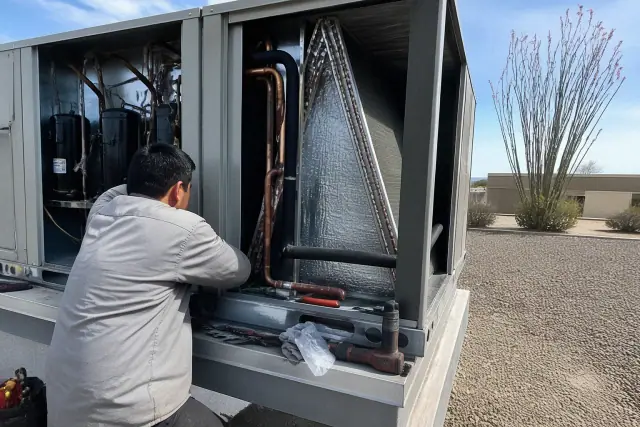
HVAC technician performing a seasonal rooftop unit tune-up in Tempe, AZ.

Technicians isolate compressor failures, refrigerant leaks, electrical faults, and control problems on package units, split systems, and VRF equipment. Electrical readings, refrigerant pressures, and airflow measurements guide the repair recommendation instead of a part-swap guess.

Explore Service

Commercial HVAC Installation & Replacement

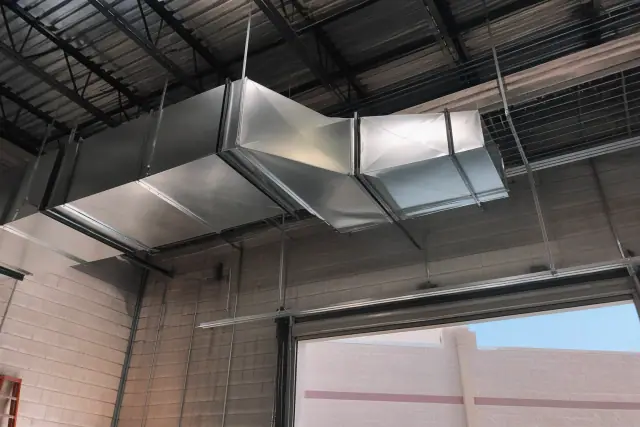
Galvanized steel HVAC ductwork installed on the ceiling of an industrial warehouse in Tempe, AZ.

New construction, tenant improvements, and ground-up commercial builds are sized with ACCA Manual N calculations based on square footage, occupancy, and kitchen or process loads. Replacement work can include demolition, crane coordination, curb adapter fabrication, City of Tempe permitting, and startup commissioning.

Explore Service

Commercial HVAC Maintenance

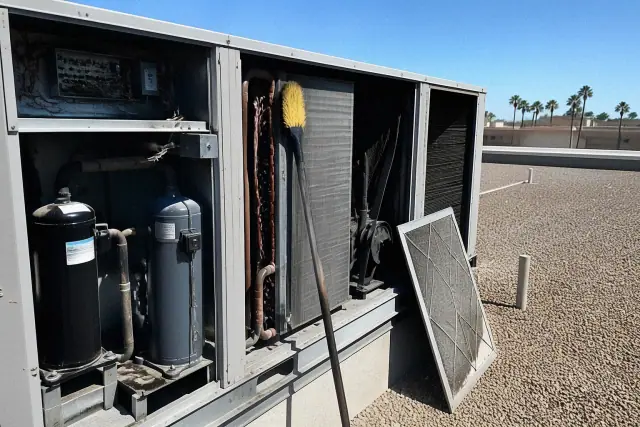
Technician performing a seasonal HVAC tune-up on a commercial rooftop unit in Tempe, AZ.

Quarterly or semi-annual maintenance includes coil cleaning, refrigerant-charge verification, belt and bearing inspection, electrical tightening, and condensate-line service. Mid-size commercial facilities typically budget $0.15 to $0.30 per square foot annually, and scheduled care can be the difference between a system reaching 20 years and failing at 10.

Explore Service

Rooftop Unit (RTU) Service & Replacement

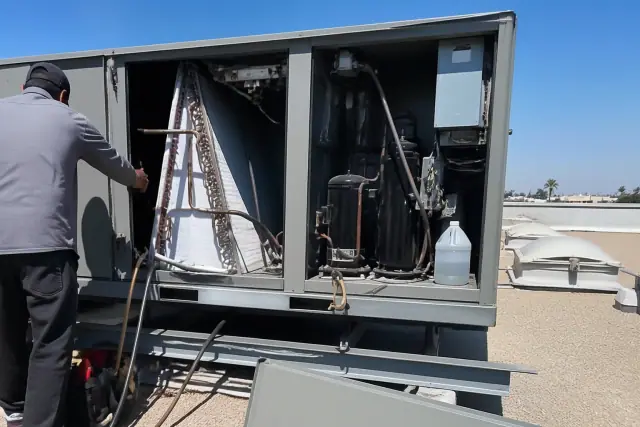
Technician performing a seasonal tune-up on a commercial HVAC rooftop unit in Tempe, AZ.

Tempe membrane roofs can exceed 150 degrees at the surface in summer, exposing RTUs to relentless heat. Service covers condenser fan motors, economizer dampers, gas heat exchangers, full unit changeouts, curb flashing, duct transitions, and roof penetrations.

Commercial Refrigeration

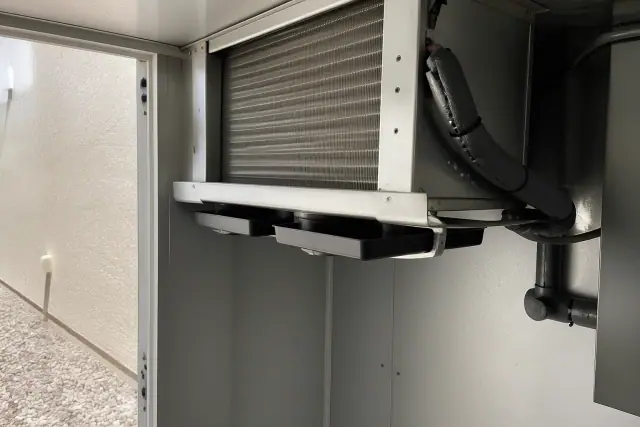
Commercial refrigeration unit with copper lines inside a walk-in cooler at a job site in Tempe, AZ.

Commercial refrigeration service addresses walk-in coolers, reach-in units, ice machines, compressor racks, evaporator fan motors, defrost timers, and condenser coils. Accurate diagnosis helps restaurants, grocery stores, and convenience stores protect temperature-sensitive inventory.

Commercial Ductwork

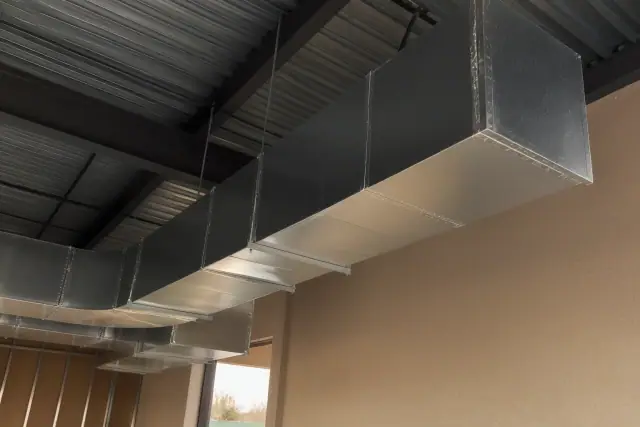
Galvanized steel ductwork installation in a Tempe, AZ commercial building with desert sunlight on a stucco wall.

Sheet-metal ductwork is designed and fabricated to SMACNA standards for tenant buildouts and older-building retrofits. Static-pressure testing identifies airflow restrictions and leakage, while mastic-sealed joints provide a more durable repair than tape alone.

Building Automation & HVAC Controls

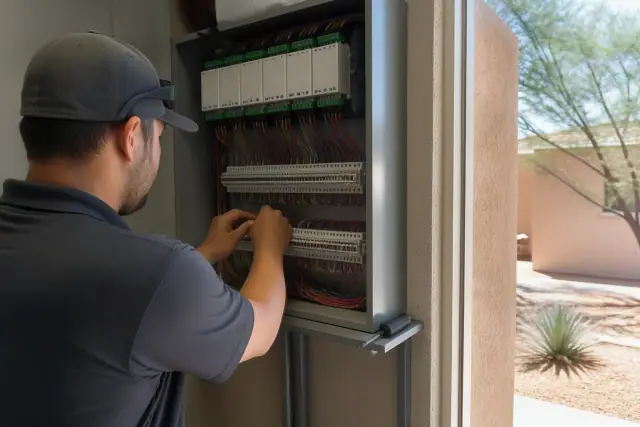
Technician wiring a commercial HVAC control cabinet in a mechanical room in Tempe, AZ.

BACnet-compatible controls can bring rooftop units, VRF zones, and commercial thermostats into one facility dashboard. Programming includes schedules and setback strategies that reduce unnecessary overnight cycling while integrating with existing building-management platforms.

Commercial Indoor Air Quality

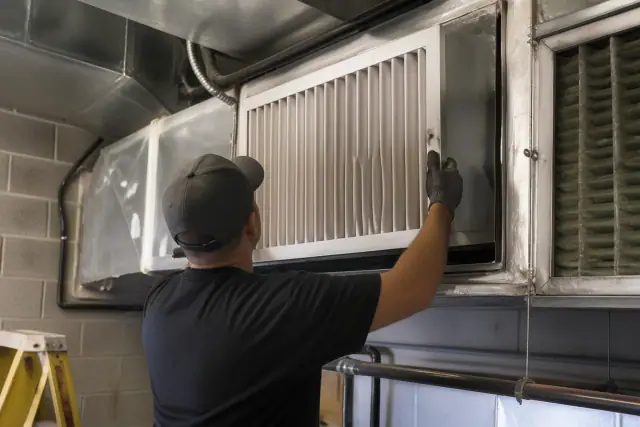
Contractor installing a commercial air purification unit into ductwork in a Tempe, AZ building.

Dust storms, pollen, and monsoon humidity strain commercial filtration and ventilation in Tempe. Available solutions include MERV-13 filtration upgrades, UV-C germicidal lighting, and dedicated outdoor-air systems for offices, medical suites, and retail spaces.

VRF System Service

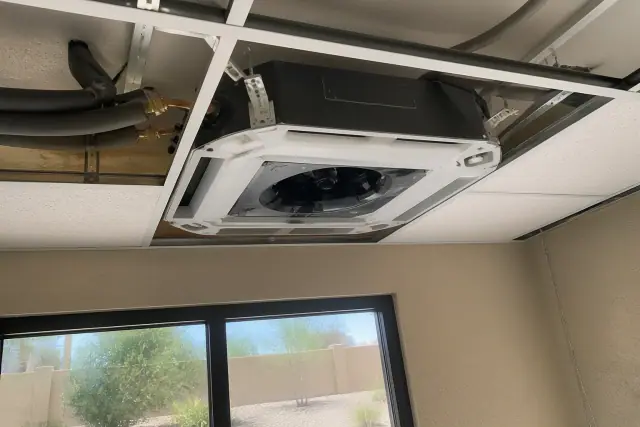
Technician installing a ceiling-cassette VRF indoor unit in a Tempe, AZ office with visible copper refrigerant lines.

VRF service covers branch-controller diagnostics, refrigerant-piping design, outdoor-unit servicing, and communication faults between indoor units and central controls. Mini-split service is also available for smaller tenant spaces that need flexible zoning.

Restaurant HVAC & Kitchen Ventilation

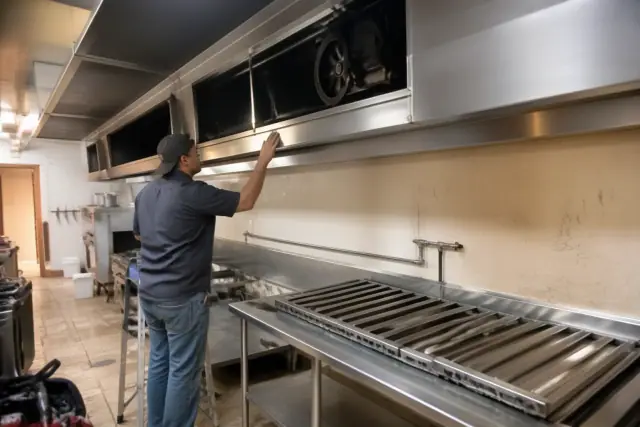
Contractor inspecting the interior motor and ventilation housing of a commercial kitchen hood in Tempe, AZ.

Restaurant service includes hood fans, makeup-air units, commercial exhaust systems, and grease-duct assemblies. Work accounts for NFPA 96 standards and Maricopa County health-inspection requirements, including the makeup-air imbalances common near Mill Avenue and the ASU corridor.

Service Selection

How to Choose Commercial HVAC Service in Tempe

The right scope starts with the equipment type, measured failure, building load, and operating schedule. A commercial contractor should explain whether repair, maintenance, controls work, or replacement addresses the root cause and should document what the proposed work includes.

Equipment-Level Diagnostics

Look for diagnosis based on electrical readings, refrigerant pressures, airflow, and equipment history. Commercial loads differ sharply from residential systems, especially for a 20-ton package unit serving a restaurant on a 115-degree afternoon.

Commercial Load Calculations

Installation sizing should follow ACCA Manual N and account for square footage, occupancy, kitchen demand, and process loads. This avoids residential shortcuts and gives equipment selection a building-specific basis.

Climate-Matched Maintenance

Tempe units need maintenance intervals that reflect dust, heat, and long cooling seasons. Near high-traffic ASU corridors, coil cleaning may be appropriate quarterly rather than annually, with filter, belt, electrical, refrigerant, and drain checks included.

Complete Replacement Coordination

A commercial replacement can involve demolition, crane scheduling, curb adapters, roof flashing, permitting, and tenant coordination. The contractor should also commission the new equipment rather than treating physical installation as the final step.

Stocked Common Parts

Common OEM compressor, contactor, and control-board parts carried on service vehicles can prevent a multi-day turnaround. That preparation supports same-day repair for most Tempe calls and helps avoid waiting three days for frequently needed components.

Commercial HVAC Credentials

Phoenix Commercial HVAC carries an Arizona Registrar of Contractors commercial license. Technicians hold NATE certification and EPA Section 608 refrigerant-handling credentials for commercial mechanical and refrigerant work.

Tempe HVAC Stressors

Common Commercial HVAC Problems in Tempe

Tempe commercial systems operate through extreme rooftop heat, airborne dust, UV exposure, and sharp monsoon humidity changes. Those conditions amplify coil, drain, insulation, electrical, refrigerant, and airflow problems, so a useful diagnosis must consider both the failed component and the local operating environment.

Request HVAC Service

Extreme Rooftop Heat

Compressors working against 110-plus-degree ambient temperatures run long cycles that accelerate wear on bearings and windings. Heat reflected by flat roofs further burdens condenser coils and rooftop electrical components.

Dust and Pollen Buildup

Dust from unpaved lots and construction sites settles into condenser fins, while seasonal pollen loads filters and coils. Fouling restricts heat transfer, raises head pressure, and forces equipment to run longer than a clean system.

Monsoon Condensate Overload

Summer monsoon humidity can overload evaporator coils and drainage systems designed around Tempe's normally dry climate. Clogged or undersized condensate paths can then send water into ceilings and occupied retail or office space.

UV and Heat-Cycle Wear

Intense UV exposure degrades rooftop cabinet gaskets and electrical insulation, while daily expansion and contraction can loosen refrigerant-line fittings. Insulation and roof-penetration seals should be checked whenever rooftop equipment is serviced.

Electrical and Control Faults

Failed capacitors, contactors, control boards, and communication circuits can stop equipment or create damaging short-cycling. Proper testing separates the primary fault from secondary electrical or control problems before work is approved.

Duct Leakage and Airflow Loss

Undersized ducts, loose transitions, and unsealed joints can waste conditioned air before it reaches the occupied space. A poorly insulated supply run crossing a 140-degree attic can surrender a meaningful share of system efficiency even when the HVAC unit itself is operating.

Why Choose Us

Why Tempe Businesses Choose Local Expertise

Commercial HVAC decisions affect tenant comfort, restaurant operations, refrigerated inventory, and facility budgets. Phoenix Commercial HVAC combines desert-specific system knowledge with documented estimates, commercial credentials, and measured startup checks so property managers can evaluate the work clearly.

Desert-Climate Knowledge

Service recommendations account for Salt River Valley dust, Tempe rooftop temperatures, monsoon moisture, and heavy commercial occupancy. That local context guides coil-cleaning frequency, drain inspection, insulation checks, and replacement planning.

Clear Estimates and Records

Written estimates identify labor, parts, and code-required upgrades before work starts. If a secondary fault or duct issue appears mid-repair, work pauses for approval, and maintenance visits are documented with photos and readings for future planning.

Measured Startup Commissioning

New equipment is commissioned with airflow verification, refrigerant-charge confirmation through superheat and subcooling measurements, and controls programming. These checks confirm that the installed system is operating as intended before the project is considered complete.

Simple Process

Our Commercial HVAC Service Process in Tempe

Each call moves from equipment history and measured diagnosis to a clear scope, approved work, and documented verification. Installation and replacement projects add load calculations, permitting, equipment selection, and scheduling that limits disruption to tenants or customers.

01.

Review the Equipment and Site

The technician reviews available equipment history, inspects the rooftop unit and duct transitions, and notes visible wear, corrosion, insulation damage, or seal degradation.

02.

Measure System Performance

Electrical readings, motor amp draw, refrigerant pressures, and airflow measurements identify the actual failure point and show whether the equipment is delivering rated capacity.

03.

Explain Findings and Estimate

Repair findings and a written estimate are presented for approval. Commercial repair costs may run from a few hundred dollars for straightforward electrical or capacitor work to several thousand for compressor or heat-exchanger replacement, and the estimate explains where the repair falls.

04.

Plan the Correct Scope

For installation or replacement, the plan covers a site walk, load calculation, equipment selection, City of Tempe permitting, and any crane, curb, ductwork, or roof-flashing coordination.

05.

Schedule and Complete the Work

Work is scheduled around building operations to limit disruption to tenants, customers, or kitchen service. Repair, installation, and supporting mechanical work follow the approved scope.

06.

Commission and Document

The completed system is checked for airflow, refrigerant charge, drainage, electrical performance, and controls operation as applicable. Photos and readings create a useful record for maintenance, warranty documentation, and future replacement planning.

Service Results

Commercial HVAC Outcomes for Tempe Businesses

Case Study 1: Repair clarity: Measured diagnostics and an itemized estimate show whether a repair addresses the actual electrical, refrigerant, airflow, or control failure before work begins.

Case Study 2: Replacement planning: Most commercial systems last 15 to 20 years with proper maintenance, so age, repair cost, service history, and building load all belong in the replacement decision.

Case Study 3: Maintenance value: The U.S. Department of Energy estimates effective commercial HVAC operations and maintenance can reduce energy costs by 5 to 20 percent; in this climate, a properly maintained system can reach 20 to 25 years, while a neglected one may fail well before 15 years.

Plan Your Service

Schedule a Commercial
HVAC
Consultation

Request an estimate for commercial HVAC repair, maintenance, installation, replacement, controls, refrigeration, ductwork, or ventilation in Tempe. Share the equipment type, building use, symptoms, and operating impact so the service conversation can start with the right context.

Tempe HVAC Help

FAQs About Commercial HVAC in Tempe, AZ

These answers cover inspections, repair response, maintenance, replacement planning, rooftop equipment, and specialized commercial systems in Tempe. For building-specific guidance, share the equipment type, symptoms, property use, and service history.

Call Our HVAC Team

A thorough inspection covers the rooftop unit, electrical connections, refrigerant lines, duct transitions, and visible wear. Technicians check motor amp draw, refrigerant pressures, and airflow with an anemometer, then document corrosion, seal damage, or other concerns with photos.

Same-day commercial HVAC repair is available for most calls within the Tempe service area. Common OEM parts are carried on service vehicles to reduce multi-day delays, although the required component and repair scope determine what can be completed immediately.

Yes. The company provides 24/7 commercial HVAC service for businesses that cannot afford extended downtime, including restaurants and medical offices. Technicians arrive with diagnostic tools and common failure-point parts to resolve most emergency calls on the first visit.

Maintenance is scheduled quarterly or semi-annually according to the equipment and cooling demand. Units near dusty, high-traffic corridors may need coil cleaning quarterly rather than annually, along with filter, belt, electrical, refrigerant, and condensate checks.

Most commercial systems last 15 to 20 years with proper maintenance. In this climate, a well-maintained system can reach 20 to 25 years, while a neglected unit may fail well before the 15-year mark.

Mid-size commercial facilities typically budget $0.15 to $0.30 per square foot annually for HVAC maintenance. The actual program should reflect equipment count, system type, operating hours, and whether quarterly or semi-annual visits fit the cooling load.

Commercial HVAC repair in this market typically ranges from a few hundred dollars for straightforward electrical or capacitor work to several thousand for compressor or heat-exchanger replacement. A written estimate explains the measured failure, labor, parts, and any code-required upgrades before work starts.

Age, repair cost, service history, building load, and the condition of related components all affect the decision. Phoenix Commercial HVAC presents a replacement analysis when repeated repairs begin to stack up instead of treating equipment age alone as the answer.

Summer highs regularly clear 110 degrees, and membrane-roof surface temperatures can exceed 150 degrees. That combination raises condenser load and accelerates wear on compressors, fan motors, cabinet seals, electrical insulation, and exposed refrigerant fittings.

From July through September, humidity spikes can overload evaporator coils and condensate drainage designed for a dry climate. Regular drain inspection helps reduce the risk of overflow and water damage in ceilings, offices, and retail spaces.

Service covers package units, split systems, rooftop units, VRF systems, mini splits, commercial heat pumps, gas-fired rooftop heat exchangers, and commercial boilers used for hydronic heat. The team also works on building controls, ductwork, indoor air quality equipment, refrigeration, and kitchen ventilation.

The process includes a site walk, ACCA Manual N load calculation, equipment selection, City of Tempe permitting, and a scheduled installation window. Startup commissioning verifies airflow, confirms refrigerant charge through superheat and subcooling measurements, and programs the controls.

Walk-in coolers, reach-in units, ice machines, and compressor racks use components and operating controls that differ from space-conditioning equipment. Service may involve evaporator fan motors, defrost timers, condenser coils, or refrigeration compressors, with temperature-sensitive inventory in mind.

Yes. Restaurant HVAC service includes hood fans, makeup-air units, commercial exhaust systems, and grease-duct assemblies. Work accounts for NFPA 96 standards and Maricopa County health-inspection requirements, including makeup-air balance problems common near Mill Avenue and the ASU corridor.

Service covers Central Tempe, Downtown Tempe, Mill Avenue, the ASU campus area, East Tempe near Loop 101, West Tempe near Priest Drive and Rio Salado, Elliot Road, and Tempe Town Lake. Coverage also extends to Guadalupe, South Scottsdale, West Mesa, Chandler, southern Phoenix, and the broader Maricopa County commercial corridor.