Proudly serving Phoenix, Mesa, Scottsdale, Tempe, Chandler, Glendale & surrounding areasCall or Text 24/7: 480-300-4493
Aerial drone view of a residential neighborhood with Saguaro cacti and stucco homes in Phoenix, AZ.

Rooftop Unit (RTU) Service, Maintenance & Replacement in Phoenix, AZ

Phoenix Commercial HVAC provides rooftop unit (RTU) service and replacement for property owners and facility managers across Phoenix and the Valley. We diagnose, maintain, repair, size, and install package units from 3-ton light-commercial systems through 25-ton equipment used on big-box retail and distribution centers. Our work covers gas-electric, heat-pump, and straight-cool configurations, along with curb adapters and economizers. We also support related commercial HVAC repair, installation, maintenance, ductwork, controls, indoor air quality, refrigeration, VRF systems, and restaurant ventilation.

Phoenix roof surfaces regularly exceed 150°F in summer, while ambient temperatures can remain at 110°F or higher for weeks from May through September. That sustained heat puts compressors, condenser coils, and belts under constant thermal stress. Our technicians use Manual N commercial load calculations, hold EPA Section 608 certification for refrigerant handling, and evaluate airflow and operating data before recommending repair or replacement. We follow ASHRAE and SMACNA standards for ductwork and airflow work and coordinate applicable City of Phoenix and Maricopa County Air Quality Department permits.

Request an on-site assessment for a documented repair-or-replace recommendation and a written, itemized quote before work begins.

Phoenix Commercial HVAC provides rooftop unit service and replacement in Phoenix and the surrounding metro, including Scottsdale, Tempe, Mesa, Glendale, Chandler, and Peoria.

★ ★ ★ ★ ★4.9/5.0 Customer Rating · 31 Years of HVAC Experience · Thousands of Commercial Systems Serviced · Licensed, Bonded & Insured · Serving Commercial & Industrial Properties

Rooftop Unit Service, Repair & Replacement

What Does RTU Service Include?

Service begins with the symptoms your building is showing, such as cycles under ten minutes, intermittent warm air, or a space that takes longer to reach setpoint. We inspect refrigerant charge, the TXV, condenser-coil condition, economizer operation, belts, bearings, electrical components, and airflow, then compare actual delivered capacity with the unit's nameplate rating.

When the failure is isolated, repair may involve a contactor, capacitor, blower motor, refrigerant fitting, belt, bearing, or compressor. Catching belt and bearing wear early matters because a repair around $300 can become a $3,000 repair if vibration damages a heat exchanger or throws a blower wheel.

Replacement becomes more practical as an RTU passes 12-15 years, develops a failed compressor, or accumulates repeat repairs. Compressor replacement on an older unit can run $3,000-$6,000 after labor, refrigerant, and recovery, so we compare that investment with the condition of the cabinet, coils, and electrical components.

Benefits of Professional RTU Service

A measured service approach helps restore cooling capacity, control operating costs, and build a useful history for capital planning. Dirty coils, failed economizers, or low refrigerant charge can leave a unit operating 20-30% below rated efficiency through a Phoenix summer.

  • Delivered-capacity checks against the nameplate rating
  • Early detection of refrigerant leaks and failing TXVs
  • Cleaner coils for more effective heat rejection
  • Correct belt tension and bearing condition
  • Clear drain pans and condensate lines
  • Verified superheat, subcooling, static pressure, and amp draw
  • Repair history that supports replacement budgeting
  • Written scope before approved work begins
RTU Service & Replacement

Commercial Rooftop Unit Services

From performance testing and component repair to planned replacement and emergency stabilization, each service is matched to the unit's condition, building load, and rooftop constraints. The goal is to resolve the immediate problem while giving facility teams clear information for the next maintenance or capital decision.

RTU Diagnostics & Performance Testing

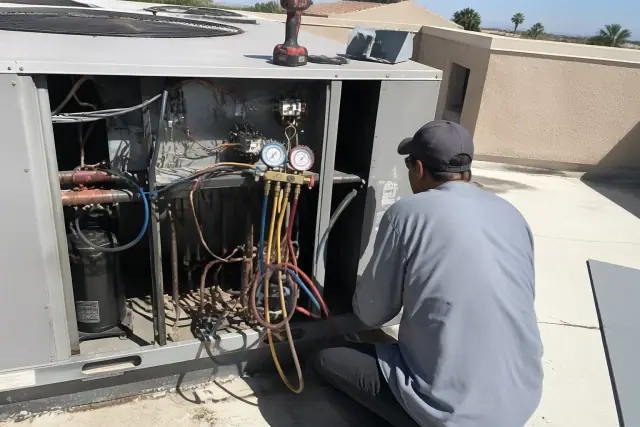
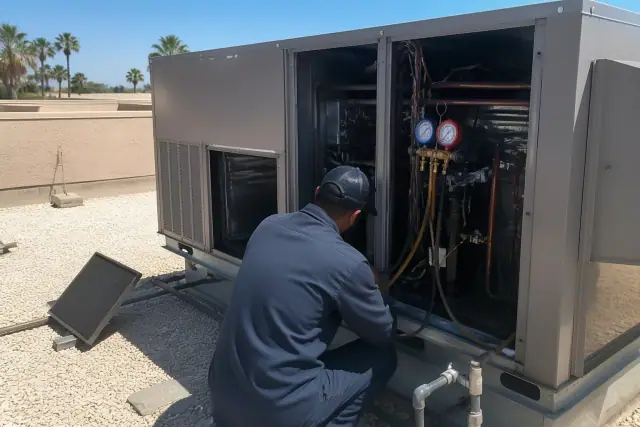
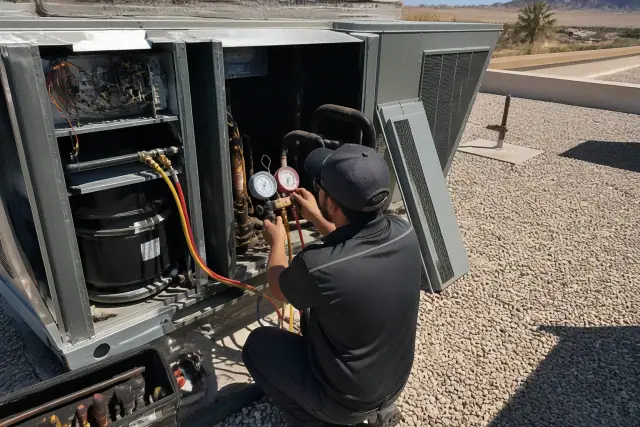
Technician performing a seasonal tune-up on a rooftop HVAC unit with manifold gauges in Phoenix, AZ.

We test amp draw, static pressure, superheat, subcooling, refrigerant charge, and delivered capacity instead of relying on symptoms alone. The resulting readings help separate airflow, electrical, refrigeration, and control problems before parts are recommended.

Request Estimate

Component & Compressor Repair

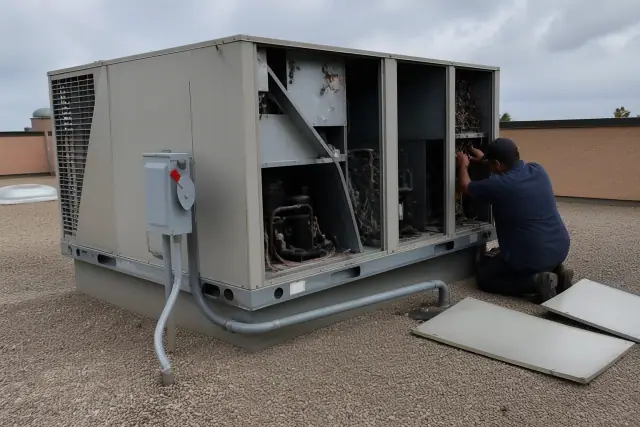
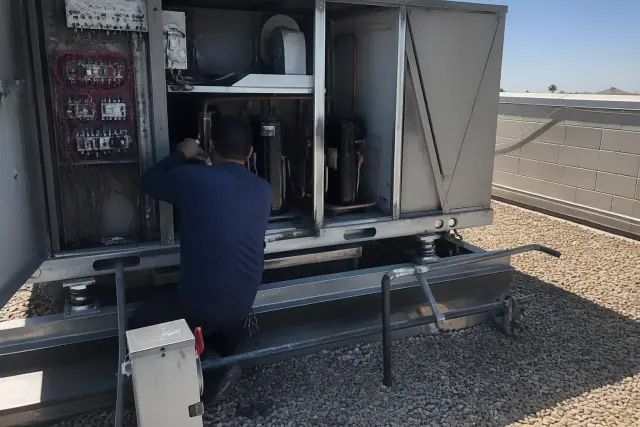
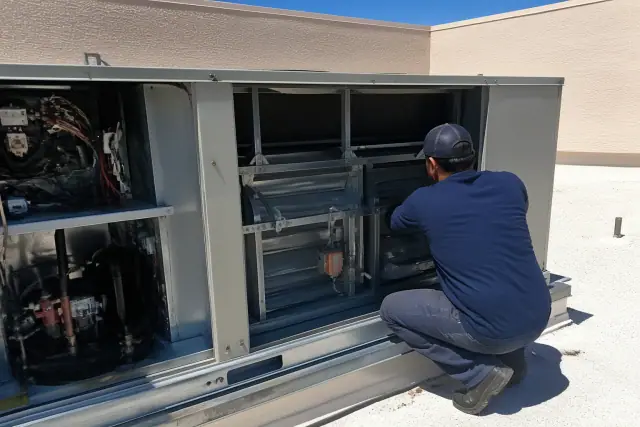
Technician performing a seasonal tune-up on a commercial rooftop unit in Phoenix, AZ.

An RTU under 10 years old with an intact compressor and an isolated contactor, capacitor, motor, fitting, or belt failure is usually a strong repair candidate. We also review the past 2-3 years of service history so one repair is considered in the context of recurring failures.

Request Estimate

Rooftop Unit Replacement

Newly installed rooftop commercial HVAC unit on a gravel roof in Phoenix, AZ.

A common 5-10 ton package-unit replacement in Phoenix typically runs $8,000-$22,000, including equipment, crane placement, curb adaptation, and startup. Larger 15-25 ton systems and projects requiring structural roof work or duct changes can push toward $30,000-$35,000; installed pricing generally falls between $1,800-$2,500 per ton for larger commercial systems and $2,800-$3,500 per ton for smaller units.

Request Estimate

Preventive RTU Maintenance

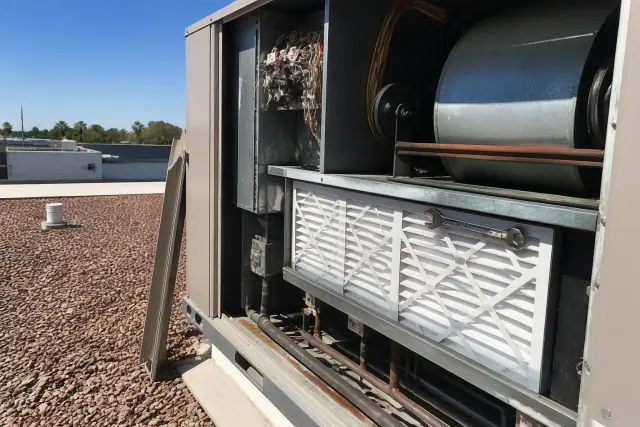
Technician performing a seasonal maintenance tune-up on a rooftop HVAC unit in Phoenix, AZ.

We recommend service twice a year: a pre-summer visit in March or April and a fall visit for heating components and accumulated wear. Consistent maintenance can add 3-4 years of usable service life compared with reactive repairs alone, meaningful deferral when a unit may cost $15,000-$25,000 to replace.

Request Estimate

Curb, Ductwork & Crane Coordination

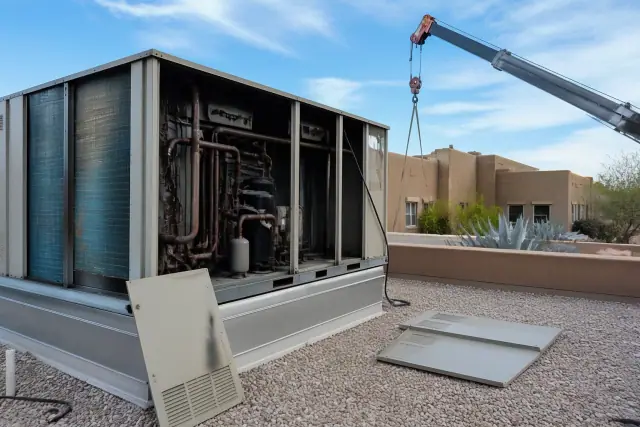
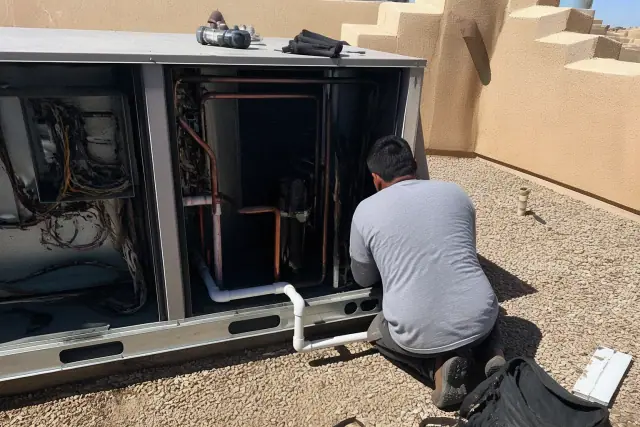
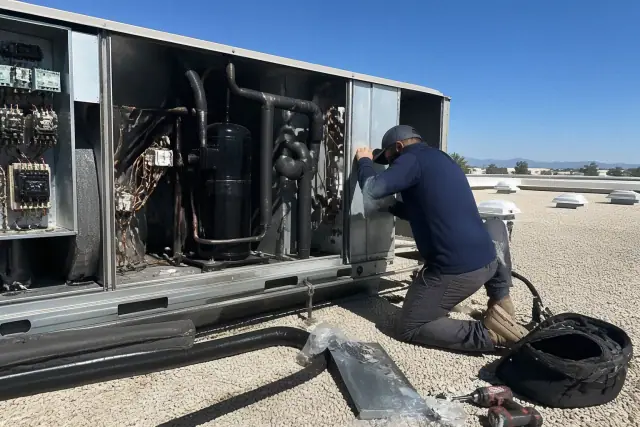
Technician servicing a rooftop HVAC unit with exposed coils and ductwork on a gravel roof in Phoenix, AZ.

Replacement planning covers curb inspection and adaptation, rigging and crane placement, electrical reconnect, applicable gas-line work, and duct transitions. We inspect and reseal connections at the curb because a mismatched transition can waste energy even when the new unit is operating correctly.

Request Estimate

Emergency System Stabilization

Technician performing seasonal maintenance on a commercial rooftop HVAC unit in Phoenix, AZ.

A failed unit serving a restaurant kitchen, medical office, server room, or occupied commercial space can require urgent attention because indoor temperatures may climb past 100°F within a few hours. Diagnostic fees typically start around $80 and are applied toward repair when work moves forward; when replacement is required, portable spot cooling or partial system function may help stabilize the space while equipment, crane access, and permits are coordinated.

Request Estimate
RTU Configurations

Commercial Rooftop Unit Options

Package-unit configuration, capacity, curb footprint, electrical service, gas requirements, economizer controls, and duct layout all affect the correct repair or replacement scope. We evaluate the installed conditions and calculate the commercial load before selecting equipment.

Technician performing a seasonal tune-up on a gas-electric rooftop unit in Phoenix, AZ.

Gas-Electric Package Units

Gas-electric RTUs combine the packaged rooftop components with gas heating where applicable. Service and replacement planning accounts for the refrigeration circuit, airflow, electrical disconnect, gas-line work, curb fit, and heating inspection.

  • Manual N commercial load calculation
  • Gas connection work when applicable
  • Electrical disconnect and reconnect
  • Curb inspection and adaptation
  • Heating-component fall inspection
Request Estimate
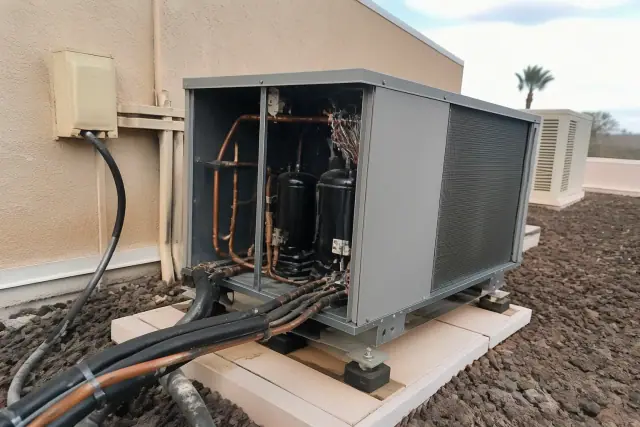
Heat pump package units on a rooftop with exposed copper lines in Phoenix, AZ.

Heat-Pump Package Units

Heat-pump rooftop units require configuration-aware diagnostics before a component or complete unit is selected. We verify the refrigeration circuit, electrical capacity, delivered airflow, curb conditions, and startup performance for the installed building load.

  • Refrigerant charge to manufacturer specification
  • Superheat and subcooling readings
  • Airflow verification at startup
  • Electrical-service capacity review
  • Curb and duct-transition inspection
Request Estimate
Technician performing a seasonal tune-up on a rooftop commercial HVAC unit in Phoenix, AZ.

Straight-Cool Package Units

Straight-cool RTUs place the compressor, condenser, evaporator coil, and air handler in one rooftop cabinet. We service and replace these packaged systems for commercial spaces including restaurants, retail strips, warehouses, office parks, big-box retail, and distribution centers.

  • Condenser-coil condition check
  • Compressor and TXV diagnostics
  • Blower motor, wheel, belt, and bearing service
  • Filter and condensate-path inspection
  • Nameplate-capacity comparison
Request Estimate
Technician performing a seasonal tune-up on a commercial rooftop unit in Phoenix, AZ.

Economizer-Equipped RTUs

A failing economizer can contribute to reduced cooling capacity and higher operating costs. We include economizer operation in the broader review of controls, airflow, refrigerant charge, coil condition, and delivered performance.

  • Economizer operation check
  • Control and electrical inspection
  • Static-pressure measurement
  • Delivered-capacity testing
  • Replacement compatibility review
Request Estimate
Technician performing a seasonal tune-up on a commercial rooftop unit in Phoenix, AZ.

High-Performance Replacement Units

For equipment approaching replacement, high-performance RTU specifications and higher-SEER2 options can be considered during planned budgeting. Units built to that high-performance specification can reduce energy use by 40-50% compared with a 2016 ASHRAE-baseline unit of the same tonnage.

  • Higher-SEER2 equipment review
  • Same-tonnage performance comparison
  • Manual N sizing before selection
  • Capital planning after the 12-year mark
  • Roof access and crane scheduling
Request Estimate
Finding Your Right Fit

Choosing the Right RTU Approach

The right path depends on commercial load, measured performance, unit age, failure type, repair history, and the rooftop work a replacement would require. We connect those factors in a practical repair, maintenance, or replacement recommendation rather than treating age or one failed part as the entire decision.

Load-Based Equipment Sizing

We use Manual N commercial load calculations before sizing a replacement rather than automatically matching the existing tonnage. That method supports selections across the 3-ton to 25-ton package-unit range described for Phoenix commercial properties.

Documented Operating Data

Each maintenance visit records superheat, subcooling, static pressure, and amp draw, building a performance history instead of a simple checklist. For major failures, we can add oil analysis when warranted and verify that a TXV or contactor issue is not mimicking compressor trouble.

Phoenix-Ready Project Planning

We account for roof access, crane scheduling, curb condition, electrical capacity, duct transitions, equipment lead time, and applicable permits before replacement begins. Payment planning can also be structured around fiscal-year budgets, capital schedules, and equipment financing, with an itemized quote showing what is being approved.

What Sets Us Apart

Why Choose Us for Rooftop Unit Service?

Phoenix Commercial HVAC combines EPA Section 608-certified refrigerant handling with technicians trained on curb adapters, economizers, and common commercial package-unit configurations. Our airflow and ductwork practices follow ASHRAE and SMACNA standards, while stocked service vehicles cover common commercial failure points to reduce delays when an isolated part can restore operation.

Request On-Site Assessment

Short Cycling and Warm Air

Cycles shorter than ten minutes, intermittent warm air, or a growing delay in reaching setpoint can point to low refrigerant charge, a failing TXV, restricted heat rejection, or another internal problem. Testing identifies the cause before prolonged high head pressure adds compressor stress.

Grinding, Squealing, or Vibration

Grinding, squealing, or rhythmic thumping often traces to a worn blower bearing, slipping or cracked belt, or loose blower wheel. We also check isolation pads and curb mounting because a poorly seated rooftop unit can transmit vibration into the ceiling grid below.

Dirty Coils and High Head Pressure

Salt River Valley dust storms and cottonwood debris can pack condenser fins and reduce heat rejection. A coil that is 30% blocked can raise head pressure enough to trip high-pressure safety switches on a 115°F afternoon.

Rising Utility Bills

A summer utility increase without a matching change in occupancy or operating hours may indicate dirty coils, a failing economizer, low refrigerant charge, or deteriorating capacity. Measured performance shows whether maintenance can restore output or the equipment is approaching replacement.

Aging Compressors and Repeat Failures

Reduced capacity, elevated head pressure, hard-starting, locked-rotor conditions, overloads that will not reset, low amp draw with no cooling, and oil residue at fittings can signal compressor trouble. Coils, braze joints, and electrical components also deteriorate from Phoenix heat and thermal cycling as an RTU ages.

Drain, Belt & Electrical Wear

Filter condition, belt tension, drain-pan and condensate-line clearance, and electrical connections all need routine attention. Addressing those items between peak seasons helps prevent small wear issues from becoming cooling interruptions.

How It Works

Our Rooftop Unit Service Process

The process moves from building symptoms and measured RTU performance to a clear repair, maintenance, or replacement scope. For installations, it continues through equipment sizing, rooftop logistics, commissioning, airflow verification, and documented handoff.

01.

On-Site RTU Assessment

We review the building's comfort problem, occupancy and operating-hour context, unit age, configuration, visible condition, and service history. Roof access, curb mounting, isolation pads, duct connections, and the equipment footprint are included in the inspection.

02.

Load & Performance Measurement

For replacement, we calculate the commercial load with Manual N rather than repeating the old tonnage by default. For service, we compare delivered capacity with the nameplate and record refrigerant, airflow, pressure, and electrical readings.

03.

Repair-or-Replace Review

We consider age, compressor condition, current repair cost, refrigerant type, efficiency, and repair history. The $5,000 guideline multiplies unit age by repair cost: a $1,200 repair on a 5-year-old unit is easier to justify, while the same repair on a 9-year-old unit reaches the guideline's line.

04.

Written Itemized Quote

Before work begins, we provide an itemized quote that identifies the approved repair or replacement scope. Replacement pricing reflects equipment, curb needs, crane placement, electrical and gas work when applicable, duct modifications, refrigerant, commissioning, and permitting requirements.

05.

Rooftop Repair or Installation

For repairs, technicians address the verified failure point and recheck operation. For replacement, the work can include curb adaptation, rigging and crane placement, electrical reconnect, applicable gas-line work, refrigerant charging, and duct-transition sealing.

06.

Startup & Service Documentation

A replacement is commissioned with airflow verification and refrigerant charge set to manufacturer specification. Service readings and completed work are documented so the property team has a performance record for future maintenance and budget decisions.

Request an On-Site Assessment

Plan Your Rooftop Unit Service

Tell us what the RTU is doing, which space it serves, and whether you are facing an active failure or planning ahead. Phoenix Commercial HVAC will assess the installed equipment and provide a written scope for service, maintenance, or replacement.

Rooftop Unit Help

Phoenix Rooftop Unit FAQs

These answers cover common Phoenix commercial RTU questions about cost, service life, maintenance, repair decisions, installation scope, and failure symptoms.

Call Our Experts

Most common 5-10 ton package-unit replacements fall between $8,000 and $22,000, including equipment, crane placement, curb work, electrical connection, and startup commissioning. Larger 15-25 ton systems or projects needing structural reinforcement or substantial ductwork can run $25,000-$35,000. An on-site assessment is needed for an itemized building-specific quote.

The $5,000 rule multiplies the unit's age in years by the estimated repair cost; when the result exceeds $5,000, replacement may be the more financially sound direction. It is a starting point, not the only factor. Refrigerant type, efficiency, compressor condition, and repair history also belong in the decision.

Yes. RTU stands for rooftop unit, a packaged HVAC system that places the compressor, condenser, evaporator coil, and air handler in one cabinet mounted on a roof curb. This configuration is common for restaurants, retail strips, warehouses, and office parks.

Rooftop placement preserves ground-level space for parking, retail frontage, or outdoor seating and works well with the single-story, flat-roof construction common across the Valley. It can simplify supply and return duct routing, reduce equipment noise and vibration near occupied areas, and keep machinery away from foot traffic, landscaping, and vandalism risk.

Commercial RTUs are rated nationally for roughly 15-20 years, but Phoenix units without disciplined maintenance often fall closer to 12-15 years because of longer compressor run time and intense rooftop heat. Units relying only on reactive repairs may fail nearer year 10-12, while consistent seasonal maintenance can help them reach the higher end of the local range.

We look at four main factors: unit age, compressor condition, current repair cost relative to age, and the full repair history over the past 2-3 years. A unit under 10 years old with an isolated component failure is often worth repairing. Equipment past 12-15 years with compressor failure or repeated service calls is more likely to justify replacement.

We recommend maintenance twice a year: once in early spring before peak cooling and once in fall to inspect heating components and address wear. Phoenix rooftop units run cooling cycles nearly year-round, so an annual visit suited to a milder climate may not catch developing problems soon enough.

Watch for short cycling, intermittent warm air, longer pull-down times, grinding, squealing, rhythmic vibration, or unexplained summer utility increases. These symptoms can trace to low refrigerant charge, a failing TXV or economizer, dirty condenser coils, loose blower components, worn bearings, or a slipping belt.

A complete replacement includes Manual N load calculation, curb inspection and adaptation or replacement, rigging and crane placement, electrical reconnect, applicable gas-line work, refrigerant charge to manufacturer specification, and startup commissioning with airflow verification. We also inspect and reseal duct connections at the curb.

Possible signs include reduced cooling capacity, elevated head pressure, hard-starting, locked-rotor conditions, internal overloads that will not reset, low amp draw without cooling, or oil residue at fittings. Diagnosis should verify amp readings, superheat, subcooling, and, when warranted, oil condition because a TXV or contactor problem can mimic compressor symptoms.

A complete failure serving a restaurant kitchen, medical office, server room, or occupied commercial space during Phoenix cooling season can create risk for inventory, equipment, staff, and customers. Indoor temperatures in an unconditioned commercial building may rise past 100°F within a few hours, making rapid diagnosis and a realistic stabilization or replacement plan important.

Maintenance documentation should include superheat, subcooling, static pressure, and amp draw, along with observations about refrigerant charge, coil and filter condition, belt tension, drains, and electrical connections. A running record makes performance changes easier to see and supports better repair and replacement planning.

Capacity, equipment selection, crane rental, curb condition, electrical-service capacity, gas-line requirements, roof structure, and ductwork changes all affect the total. Matching an existing footprint is generally a different scope from modifying the curb or reconfiguring transitions, so an on-site assessment is necessary for a useful written quote.