Proudly serving Phoenix, Mesa, Scottsdale, Tempe, Chandler, Glendale & surrounding areasCall or Text 24/7: 480-300-4493
Aerial drone view of a residential neighborhood with Saguaro cacti and stucco homes in Phoenix, AZ.

Commercial HVAC in Chandler, AZ

Phoenix Commercial HVAC serves Chandler businesses with commercial HVAC repair, installation and replacement, and preventive maintenance. We also service rooftop units, commercial refrigeration, ductwork, building automation and HVAC controls, indoor air quality equipment, VRF systems, and restaurant HVAC and kitchen ventilation. Our licensed commercial HVAC contractors work on single-tenant retail spaces, multi-story offices, and industrial plants. Each visit is built around the equipment, operating demands, and conditions at the property.

Chandler rooftops can sit under direct desert sun for ten or more hours a day, and summer temperatures regularly exceed 110°F. Long duty cycles, dust from haboob events, and monsoon humidity swings can strain compressors, coils, belts, controls, and ventilation. Precise temperature and humidity control matters for production lines, server rooms, cold storage, and occupant comfort. When a package unit short-cycles, a walk-in cooler warms, or a building automation system reports alarms, we diagnose the failure point before recommending work.

We schedule commercial HVAC service throughout Downtown Chandler, Ocotillo, Fulton Ranch, the Price Road tech corridor, and industrial parks along Chandler Boulevard and Germann Road, with multi-site coverage extending to Gilbert, Mesa, Tempe, Sun Lakes, and Ahwatukee.

★ ★ ★ ★ ★4.9/5.0 Customer Rating - 31 Years of HVAC Experience - Thousands of Commercial Systems Serviced - Licensed, Bonded & Insured - Serving Commercial & Industrial Properties
Commercial HVAC Services

Commercial HVAC Services in Chandler, AZ

From urgent diagnostics to planned capital projects, our Chandler team supports cooling, heating, refrigeration, ventilation, controls, and indoor-air systems for retail, office, restaurant, medical, industrial, and mixed-use facilities. Facility teams comparing coverage outside the East Valley can also review our Glendale, AZ service page.

Commercial HVAC Repair

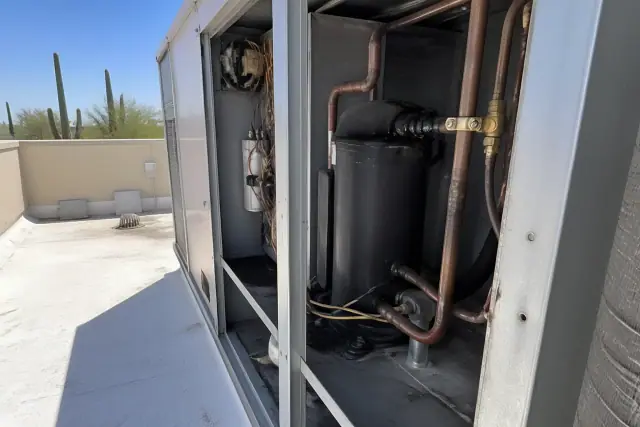
Technician performing a seasonal tune-up on a commercial HVAC rooftop unit in Chandler, AZ.

A compressor trip at 2 PM in July can interrupt customers, staff, or production, so our repair process starts with measured diagnostics. Technicians check compressor and condenser operation, refrigerant conditions, electrical controls, and airflow with digital manifold gauges and combustion analyzers. Common contactors, capacitors, and control boards are stocked on service trucks so qualifying repairs can often be completed in one visit.

Explore Service

Commercial HVAC Installation & Replacement

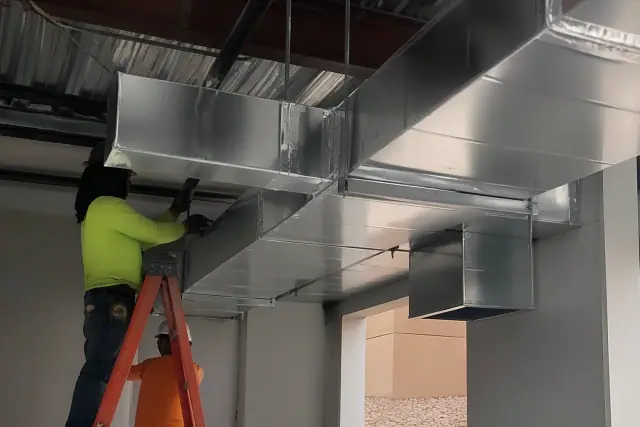
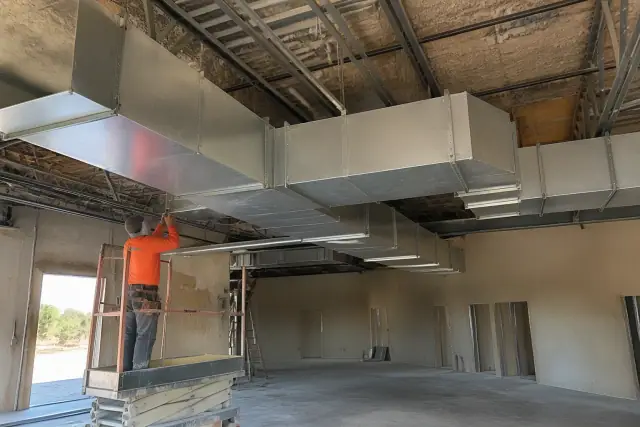
Contractors installing galvanized steel HVAC ductwork from an industrial ceiling in Chandler, AZ.

We perform load calculations and select commercial split, packaged, or multi-zone equipment for new construction, tenant improvements, and replacement projects. Installations are coordinated with the City of Chandler Building Safety Division and sized around ASHRAE 62.1 ventilation requirements, local mechanical code, and manufacturer specifications. Commercial HVAC equipment often lasts 15 to 20 years with consistent maintenance, while neglected units may fail by year 10 to 12; higher-SEER2 replacement equipment can cut energy consumption by 20% to 50% compared with aging units.

Explore Service

Commercial HVAC Maintenance

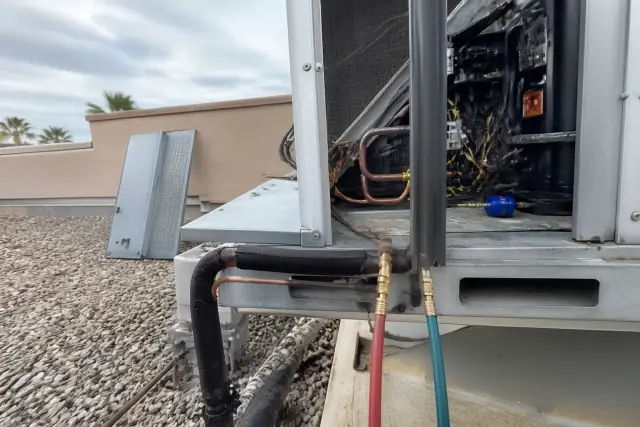
Technician performing a seasonal HVAC tune-up on a rooftop unit at a commercial building in Chandler, AZ.

Structured commercial maintenance programs typically cost between $0.15 and $0.30 per square foot annually, while clean coils alone can save roughly $610 per cooling season on a 10-ton unit. Visits cover coil cleaning, refrigerant-charge verification, belt and bearing inspection, condensate-drain clearing, and electrical-connection torque checks. Service frequency is adjusted for Chandler dust, runtime, and the operational demands of each facility.

Explore Service

Rooftop Unit (RTU) Service & Replacement

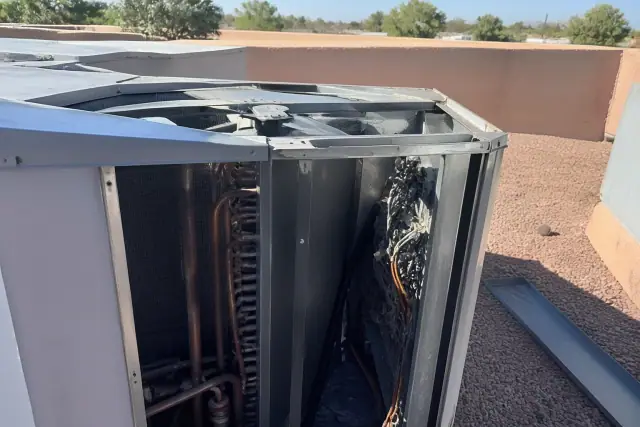
Open commercial HVAC unit with exposed coils and fan blades on a rooftop in Chandler, AZ.

We service and replace packaged rooftop units ranging from single-ton retail systems to large multi-stage equipment serving offices and industrial buildings. Direct roof exposure can shorten compressor and belt life, making accurate diagnosis and planned upkeep especially important. Replacement work matches curb dimensions, electrical requirements, and manufacturer documentation to prevent avoidable rework.

Commercial Refrigeration

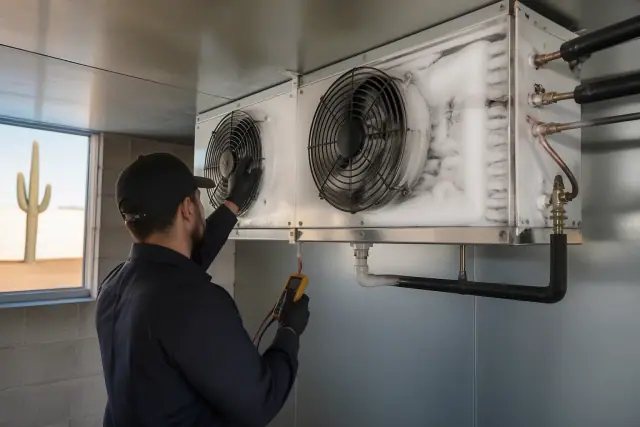
Technician repairing a walk-in cooler evaporator coil at a commercial facility in Chandler, AZ.

Commercial refrigeration service covers walk-in coolers, walk-in freezers, reach-in units, and ice machines used by Chandler restaurants, grocery stores, and convenience stores. We repair and maintain compressors, evaporator coils, and electronic controls while planning work around business operations. The goal is to restore tight temperature control and reduce the risk of product loss.

Commercial Ductwork

Sheet metal workers installing galvanized steel ductwork in a Chandler, AZ commercial building.

Undersized or poorly sealed ductwork can leave large retail and office zones with uneven temperatures even when the equipment is running. We fabricate, install, and repair sheet-metal ductwork and commercial ventilation systems to SMACNA standards. Static-pressure testing and airflow balancing verify that each zone receives the designed CFM.

Building Automation & HVAC Controls

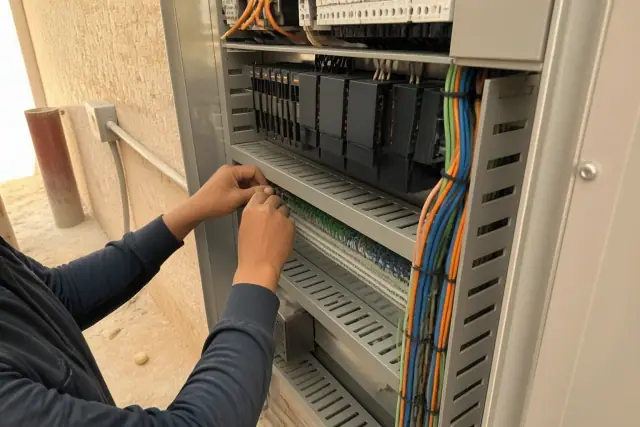
Technician wiring a building automation control cabinet with ethernet cables at a commercial site in Chandler, AZ.

Centralized building automation helps facility managers schedule equipment, control commercial zones, and monitor performance across multi-tenant buildings and corporate campuses. We install and service commercial thermostats, BAS platforms, programmable logic controllers, and variable frequency drives. Remote monitoring can surface faults early enough for a facility team to respond before they become larger failures.

Commercial Indoor Air Quality

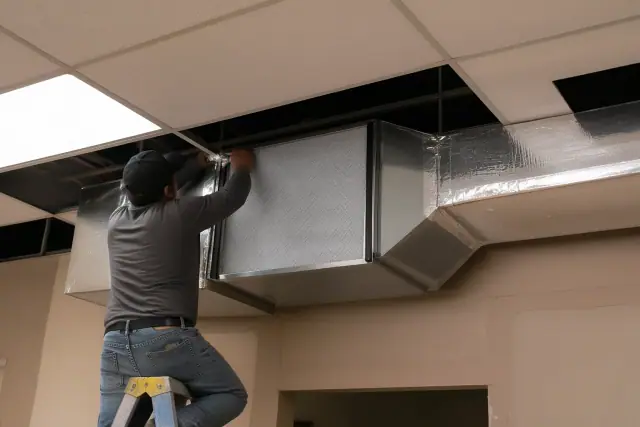
Installer securing a commercial air purification unit into metal ductwork in Chandler, AZ.

Chandler facilities may need to manage outdoor dust infiltration, indoor contaminants, and rapid humidity changes. We install and service commercial-grade filtration, UV-C germicidal lighting, ventilation upgrades, and humidity-control equipment integrated with the air-handling system. These upgrades can improve filtration beyond the standard MERV 8 filters commonly found in package units.

VRF System Service

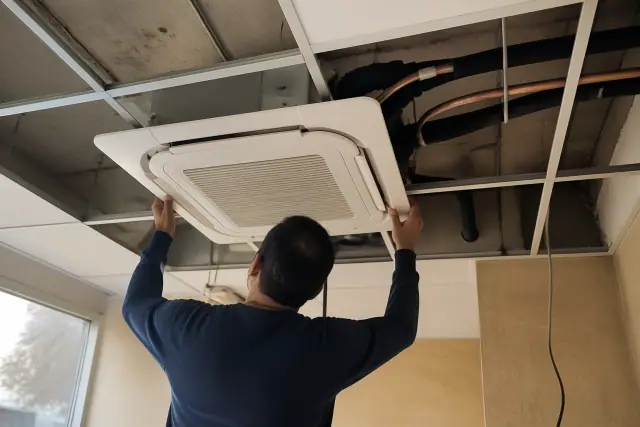
Technician installing a VRF ceiling cassette unit with insulated piping at a commercial jobsite in Chandler, AZ.

Variable refrigerant flow systems support simultaneous heating and cooling across zones in newer office and mixed-use properties. Our factory-trained technicians service major VRF platforms, including refrigerant-charge diagnostics, branch-controller troubleshooting, and outdoor-unit work. The process accounts for the precision these systems require beyond standard split-system service.

Restaurant HVAC & Kitchen Ventilation

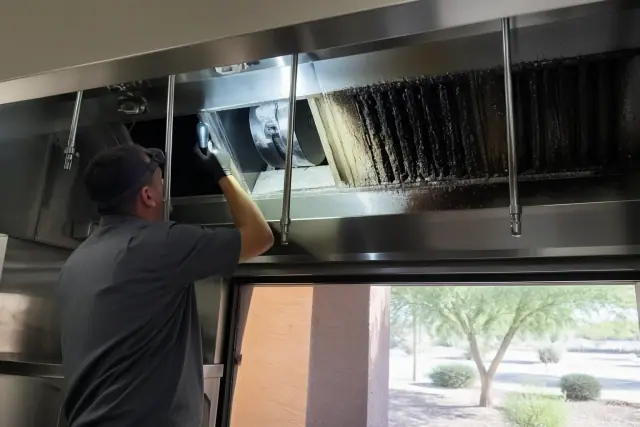
Technician inspecting a commercial kitchen exhaust hood with grease buildup in a Chandler, AZ restaurant.

Restaurant service includes dedicated dining-room and kitchen HVAC, exhaust fans, grease ductwork, hood systems, and makeup-air units. We balance makeup air against exhaust volume so negative pressure does not draw excess outdoor heat and dust into the building. Kitchen ventilation work accounts for NFPA 96, International Mechanical Code requirements, and fire-code inspection cycles coordinated through the Chandler Fire Department.

Commercial System Selection

How to Choose Commercial HVAC Service in Chandler

The right commercial HVAC approach starts with the equipment architecture, building load, operating tolerance, and applicable code requirements. A service provider should confirm the failure point with system data rather than rely on rule-of-thumb tonnage or speculative parts replacement. Facility managers should also expect clear findings, equipment-specific documentation, and a post-work performance check.

Equipment Type and Scale

Commercial systems commonly use three-phase power, larger tonnage, and package-unit, split-system, or VRF architecture. Choose a contractor familiar with the specific configuration serving your retail space, office building, industrial plant, or multi-zone facility.

Measured Diagnostics

Reliable troubleshooting uses electrical readings, refrigerant data, airflow measurements, digital manifold gauges, and combustion analyzers to separate symptoms from root causes. The technician should verify the complaint and collect system data before recommending a component or control repair.

Commercial Credentials

Commercial mechanical work in Chandler calls for the appropriate Arizona Registrar of Contractors classifications, while refrigerant handling requires EPA Section 608 certification under the Clean Air Act. Confirm that the technicians assigned to the job carry the credentials required for the equipment and work involved.

Code and Ventilation Knowledge

Installation, ductwork, and kitchen projects can involve ASHRAE ventilation criteria, Chandler's adopted International Mechanical Code, SMACNA duct practices, and NFPA 96 exhaust requirements. The contractor should account for the standards that apply before equipment or sheet metal is installed.

Exact Equipment Fit

Rooftop replacements must align with curb dimensions, electrical requirements, load calculations, and manufacturer documentation. Careful equipment selection reduces field modifications and helps the finished system deliver the airflow and capacity intended for the building.

Operational Priorities

HVAC downtime can affect production lines, server rooms, cold storage, perishables, occupant safety, and customer-facing operations. Service planning should reflect those consequences, with the highest-impact failures prioritized and realistic parts availability communicated upfront.

Chandler HVAC Stressors

Common Commercial HVAC Problems in Chandler

Direct roof exposure, extended cooling cycles, airborne desert dust, and monsoon moisture can create overlapping stresses on commercial HVAC equipment. Because the same symptom may come from airflow, refrigerant, electrical, or control faults, accurate readings matter more than assumptions. These six issues are frequent starting points for a Chandler commercial diagnostic.

Request HVAC Diagnostics

Rooftop Heat Load

From May through September, rooftop units may run near-continuous cooling cycles under direct sun. That extended runtime accelerates compressor wear and can degrade belts, rubber gaskets, and electrical insulation.

Dust-Restricted Airflow

Haboob events can deposit fine sand in condenser coils, filters, and outside-air intakes. Restricted airflow forces equipment to work harder to reject heat, making Chandler-specific coil-cleaning and filter schedules important.

Short Cycling and Control Alarms

Short cycling or repeated building-automation alarms may point to compressor, condenser, refrigerant, sensor, or control problems. Pulling system data and checking the sequence of operation helps isolate the actual failure instead of resetting the symptom.

Monsoon Humidity Swings

Monsoon season typically runs from June through September and can bring sudden humidity spikes after months of extreme dry heat. Restaurants, medical offices, and facilities with tight relative-humidity requirements may need integrated dehumidification or humidification rather than standalone equipment.

Refrigerant and Electrical Faults

Refrigerant leaks, burned condenser-fan motors, failed contactors, weak capacitors, and damaged control boards can all reduce or stop cooling. Electrical and refrigerant readings distinguish the failed component from the conditions that caused it.

Kitchen Pressure Imbalance

When restaurant exhaust volume exceeds available makeup air, the kitchen can fall under negative pressure. That imbalance may pull outdoor heat and dust through the dining area while making the HVAC system work against the ventilation system.

Why Choose Us

Why Chandler Facilities Choose Phoenix Commercial HVAC

Chandler's population was 275,987 as of the 2020 census, and its commercial base spans downtown businesses, semiconductor and aerospace facilities, financial-services offices, restaurants, and industrial sites. That variety requires commercial HVAC work grounded in equipment data, operational priorities, and local climate conditions. We combine Chandler-area familiarity with coordinated repair, replacement, maintenance, controls, refrigeration, ductwork, and indoor-air service.

Chandler Facility Knowledge

Our service context includes Downtown Chandler, Ocotillo, Fulton Ranch, the Price Road corridor near Intel and PayPal, and industrial parks near Chandler Boulevard and Germann Road. We account for the cooling, humidity, and uptime demands found across offices, restaurants, tech manufacturing, distribution, and mixed-use properties.

Connected-System Perspective

Commercial comfort and process conditions depend on more than the cooling unit alone. We evaluate interactions among rooftop or VRF equipment, ductwork, refrigeration, building controls, ventilation, filtration, and humidity management so one system is not working against another.

Clear Findings and Verification

Facility managers receive written findings and a repair recommendation before work begins. After the repair, startup verification checks temperature split, amp draw, airflow, and system operation so the result is measured rather than assumed.

Diagnostic-to-Repair Process

Our Commercial HVAC Repair Process in Chandler

Each service call moves from complaint verification to measured diagnosis, written findings, repair, and performance confirmation. Common component failures may be completed in a single visit when parts are on the truck, while compressor or major control-board work may require a return trip if regional stock is unavailable. We communicate the expected sequence before leaving a facility team without answers.

01.

Verify the Complaint

The technician confirms the reported symptom, operating mode, affected zones, alarm history, and impact on the facility before opening the diagnostic path.

02.

Measure System Conditions

Electrical, refrigerant, and airflow checks establish how the equipment is actually operating. Readings may include temperature, pressure, amp draw, control signals, and airflow conditions relevant to the complaint.

03.

Confirm the Failure Point

System data is traced to the failed component or operating condition before parts are recommended. This prevents guesswork and separates a root cause from a secondary alarm or comfort symptom.

04.

Review Written Findings

The facility contact receives the findings and recommended repair before work begins. Parts availability and the likely service timeline are explained so operations can plan around the work.

05.

Complete the Repair

Common stocked parts can support same-day completion, while larger components are sourced through regional supply channels. The repair is carried out with the equipment requirements, manufacturer documentation, and applicable code in view.

06.

Verify Startup Performance

After startup, the technician confirms temperature split, amp draw, airflow, and control response are within specification. That final check documents how the system performs after the repair instead of ending the visit when the equipment first turns on.

Operational Outcomes

Practical HVAC Outcomes for Chandler Properties

Case Study 1: Verified restoration: Component repairs are followed by startup measurements that confirm temperature split, amp draw, airflow, and control response.

Case Study 2: Balanced zones: Static-pressure testing and airflow balancing help corrected ductwork deliver the designed CFM to retail and office zones.

Case Study 3: Earlier fault visibility: BAS scheduling and remote monitoring give facility managers a clearer view of system performance and emerging alarms.

Plan Your Service

Schedule Commercial
HVAC Service in
Chandler

Tell us which equipment is affected, what the building is experiencing, and how the issue is affecting operations. We will schedule the appropriate commercial diagnostic, maintenance visit, installation discussion, or system service for your Chandler property.

Commercial HVAC Help

Commercial HVAC FAQs for Chandler, AZ

These answers cover repair-versus-replacement decisions, maintenance timing, system checks, specialized equipment, and service expectations for Chandler commercial properties.

Call Our Commercial HVAC Team

The $5,000 rule is a rough decision guideline: multiply the unit's age by the estimated repair cost, and a result above $5,000 may favor replacement. A 12-year-old unit with a $500 repair produces a score of 6,000. It is not an engineering standard, so repair history, efficiency loss, and remaining service life still need to be reviewed.

Most commercial equipment should be serviced at least twice a year, before the primary cooling and heating seasons. Chandler rooftop units with heavy runtime often benefit from quarterly maintenance, and restaurants, server rooms, or cold-storage facilities may require more frequent checks based on operating conditions.

Confirm the thermostat mode and setpoint, check the main disconnect and breakers, and look for blocked return grilles, closed dampers, a stopped condenser fan, unusual sounds, or oil residue around refrigerant fittings. Record alarms and affected zones for the technician. If basic checks do not restore operation, stop and schedule commercial diagnostics rather than working beyond safe visual inspection.

Flat commercial roofs expose packaged units to direct sun, long cooling cycles, airborne dust, and monsoon moisture. Heat accelerates wear on compressors, belts, gaskets, and electrical insulation, while dust can restrict coils and intakes. Maintenance should reflect these local conditions instead of following a schedule designed for a milder climate.

Repair may be practical when the failure is isolated and the equipment has useful service life remaining. Replacement becomes more compelling as failures accumulate, efficiency declines, or equipment approaches its expected lifespan. A load calculation, repair history, equipment age, and operating cost provide a better decision basis than age alone.

Standard repairs such as contactor, capacitor, or fan-motor replacement can often be completed in one visit when the needed part is stocked. Compressor replacements and major control-board failures may require a return trip if regional stock is unavailable. The technician should communicate parts status and timing with the written recommendation.

We service walk-in coolers, walk-in freezers, reach-in units, and ice machines used by restaurants, grocery stores, and convenience stores. Repair and maintenance may involve compressors, evaporator coils, and electronic controls, with work planned around business operations and product-protection needs.

Uneven temperatures, weak airflow, or zones that never reach setpoint can indicate undersized, leaking, or poorly balanced ductwork. Static-pressure testing and airflow balancing help determine whether each zone is receiving its designed CFM. Sheet-metal repairs or ventilation changes should follow those measurements.

A BAS can centralize scheduling, zone control, thermostat operation, and remote performance monitoring across a commercial property. Facility managers can use alarms and trend data to catch faults before they become larger failures. Service may also involve programmable logic controllers and variable frequency drives.

VRF equipment can provide simultaneous heating and cooling across multiple zones and uses branch controllers and precise refrigerant management. Diagnosis may involve refrigerant charge, branch-controller operation, and the outdoor unit as one connected system. That work requires technicians trained on major VRF platforms.

Restaurant service can include dining-room and kitchen HVAC, exhaust fans, grease ductwork, hood systems, and makeup-air units. Balancing makeup air against exhaust volume helps prevent negative pressure. Ventilation work must also account for NFPA 96, International Mechanical Code requirements, and local fire-inspection cycles.

Options include commercial-grade filtration, UV-C germicidal lighting, ventilation upgrades, and integrated humidity control. These systems can address desert dust, indoor contaminants, and monsoon moisture while working with the existing air handler. Filtration upgrades can go beyond the standard MERV 8 filters common in package units.

We prioritize commercial failures that threaten perishables, occupant safety, or production continuity. For common failures with stocked parts, we aim to diagnose and complete the repair the same day. Larger components or unavailable regional stock can extend the timeline, and that status is communicated upfront.

Yes. Although Chandler winters are mild, commercial gas furnaces, electric heating systems, and boilers still require service in December and January. Facilities with process-heating demands may need heating performance beyond basic occupant comfort.

Service coverage includes Downtown Chandler, the Arizona Avenue corridor, Ocotillo, South Chandler, the Price Road tech corridor, Fulton Ranch, and West Chandler commercial districts. Multi-site coverage also extends to Sun Lakes, Gilbert, Mesa, Tempe, and Ahwatukee for facility teams managing properties across the East Valley.