Load Calculation First
Ask for an ACCA Manual N or Manual J calculation and its output sheet before accepting a tonnage recommendation. It should reflect square footage, occupancy, glazing, kitchen equipment, and block or room loads.
Phoenix Commercial HVAC explains which questions Phoenix property owners should ask before approving a commercial HVAC system replacement. Written answers about load, equipment selection, code compliance, warranties, and downtime help prevent oversized rooftop units, unexpected scope changes, and equipment that cannot meet the building's actual needs. The goal is a proposal tied to documented operating requirements, not a like-for-like assumption.
Ask for an ACCA Manual N or Manual J calculation and its output sheet before accepting a tonnage recommendation. It should reflect square footage, occupancy, glazing, kitchen equipment, and block or room loads.
Verify an active Arizona Registrar of Contractors license, liability and workers' compensation coverage, permits, and the applicable commercial code. Ask about NATE credentials, EPA 608 certification, and training on the proposed equipment line.
Compare repair and replacement by reviewing equipment age, repair history, parts availability, refrigerant, efficiency, warranties, and downtime. A complete quote should make those tradeoffs and any excluded work clear in writing.
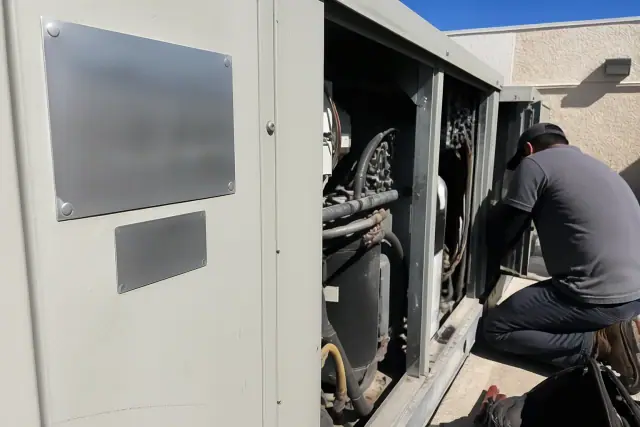
The existing unit's nameplate beside notes for equipment age and the last three years of repair history. Those details frame parts-availability and repair-versus-replacement questions.
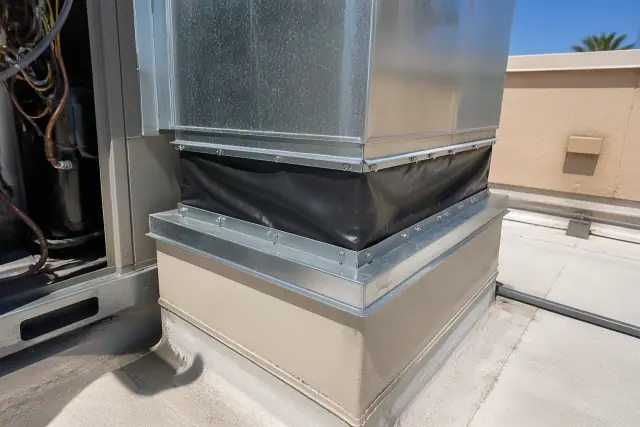
The rooftop unit curb, duct transitions, and service access on a Phoenix commercial roof. Fit, airflow, and crane access can change both scope and installation timing.
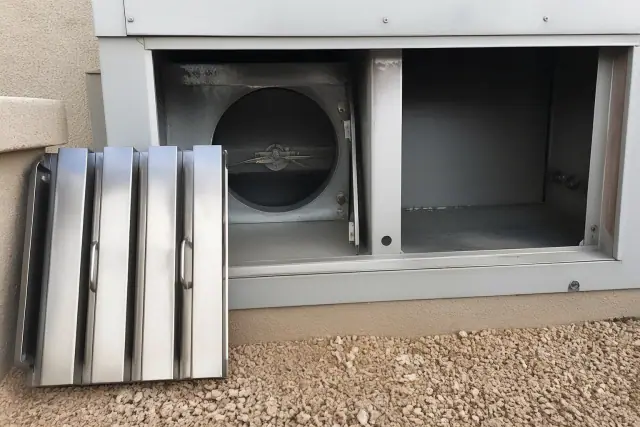
Hood exhaust and make-up air measurements being balanced in a commercial kitchen. Exhaust CFM, replacement air, and room pressure must be evaluated with the new HVAC equipment.
Record equipment age and the past three years of repairs. An R-22 or early R-410A unit past 15 years old raises different parts and refrigerant questions than a 6-year-old unit with a bad compressor.
Request final tonnage, staged or variable-speed operation, SEER2, EER2, and IEER values. Confirm high-ambient performance and whether the proposed refrigerant is R-410A or a newer A2L blend.
Confirm equipment lead time, curb-adapter needs, crane scheduling, electrical work, temporary conditioning, and controls integration. Access and continuity planning differ for downtown high-rises, Ahwatukee strip malls, and warehouses near Sky Harbor, especially in peak July and August heat.
Get parts and labor terms, registration responsibility, claim response, and maintenance conditions in writing. Many manufacturers typically expect two documented visits a year-once before summer and once before the winter heating season-and any needed 24/7 repair availability should be confirmed, not assumed.
| Question Area | A Complete Answer Should Show | Why It Matters |
|---|---|---|
| Sizing | Manual N or Manual J output, block or room loads, and final tonnage | Prevents a like-for-like guess from causing short-cycling or weak peak-load performance. |
| Equipment | Exact SEER2, EER2, and IEER values, refrigerant, staging, and high-ambient capability | Clarifies efficiency, part-load operation, and long-term service considerations. |
| Airflow and ventilation | Static pressure, duct changes, ASHRAE 62.1 outdoor air, and kitchen exhaust-to-make-up-air CFM balance when applicable | Shows whether the distribution and ventilation systems will support the new unit. |
| Controls | Compatibility with existing automation, economizers, zoning, schedules, and fault alerts | Identifies integration work before installation starts. |
| Compliance | Active ROC license, insurance, permit responsibility, applicable code, and inspection steps | Defines who is accountable for legal installation and sign-off. |
| Schedule and coverage | Lead time, crane and changeover plan, warranty terms, registration, and maintenance conditions | Makes downtime and post-installation responsibilities clear. |
A strong proposal is more than a unit model and total price. It ties load data to tonnage, explains the repair-versus-replace reasoning, states what happens to ductwork, controls, and ventilation, and defines permits, startup testing, warranty coverage, and downtime.
The $5,000 rule multiplies unit age in years by the estimated repair cost in dollars. A 12-year-old unit facing a $500 repair scores 6,000, while a 3-year-old unit with the same repair scores 1,500; use that result with parts availability, refrigerant, condition, and the expected 15-20 year service life of a commercial rooftop unit rather than as the only decision.
The most common follow-ups are how long replacement takes, how rooftop and VRF options differ, and what keeps warranty coverage valid. A straightforward single rooftop unit swap typically takes one to two days, while multi-unit, ductwork, or controls projects can take one to two weeks depending on equipment lead times and crane scheduling. When comparing RTU and VRF approaches, ask about installed scope, zoning, simultaneous heating and cooling, refrigerant-piping limits, part-load performance, maintenance documentation, and warranty registration.
Bring the property details, current equipment data, repair history, and proposed scope. A commercial HVAC professional can help a Phoenix or Salt River Valley property owner compare the load calculation, equipment, integration work, timeline, and warranty terms before approval.