Joint Leakage
Cracked mastic, worn tape, and loose plenum or branch connections let conditioned air escape. RTU vibration can work screws and strapping loose, producing whistles, rattles, and gradual airflow loss.
Phoenix Commercial HVAC sees leaking joints, undersized runs, kinked or collapsed flex duct, corrosion, and failed insulation across commercial buildings in Phoenix. These problems waste conditioned air, restrict airflow, create uneven temperatures, and make rooftop units or VRF systems run longer. The right fix depends on pressure-test findings, duct condition, access, and whether the problem is isolated or systemwide.
Cracked mastic, worn tape, and loose plenum or branch connections let conditioned air escape. RTU vibration can work screws and strapping loose, producing whistles, rattles, and gradual airflow loss.
Kinked or crushed flex duct, undersized trunks, crowded takeoffs, and too many 90-degree turns add friction before air reaches the diffuser. The result may be weak vents, hot and cold zones, high static pressure, or short cycling.
Phoenix attic and rooftop ducts can face 130 to 150 degree conditions, while monsoon humidity adds condensation cycling. Torn or compressed insulation, a broken vapor barrier, and moisture near rooftop penetrations can reduce cooling performance and corrode galvanized steel.
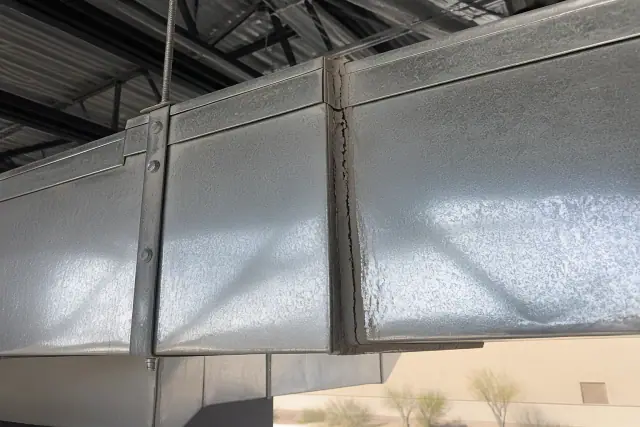
A close view should show separated seams, cracked mastic, or worn tape at a plenum or branch takeoff. These are common paths for slow air loss.
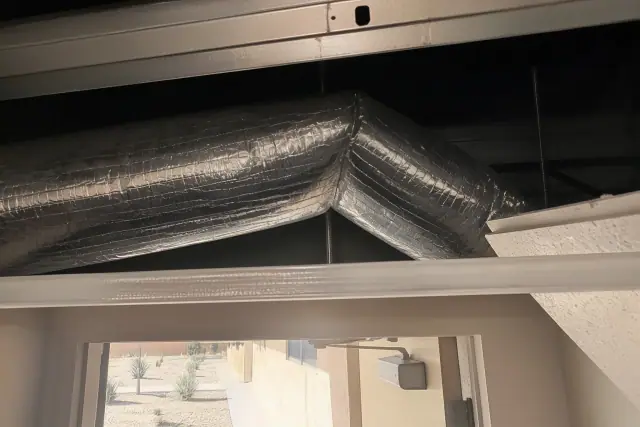
A flexible run pinched around an obstruction or sagging after a support strap fails. The restriction explains weak airflow at a diffuser.
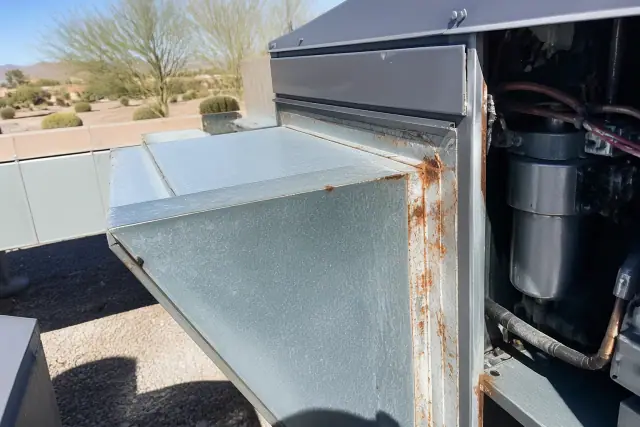
Damaged insulation, moisture, and early corrosion near a rooftop penetration or condensate line. This connects Phoenix heat and monsoon cycling to duct deterioration.
Use a manometer to check static pressure, a smoke pencil at suspect joints, and a borescope for inaccessible chases. Measurements help confirm whether the complaint starts with leakage, restriction, or contamination.
A few hundred dollars may address targeted sealing, while crushed sections, inaccessible ceiling runs, or a full redesign cost more. Square footage, duct material, access, and whether the equipment changed all affect the recommendation.
Persistent hot or cold zones, sagging duct, corrosion, musty odors, and rising energy use warrant evaluation. Exterior condensation can damage ceiling tile, while mold, pests, grease, or renovation debris call for contamination-specific action.
Duct cleaning is appropriate when visible contamination, renovation dust, pests, or mold are documented, not for every system by default. At minimum, annual maintenance can cover accessible runs, static pressure, dampers, and insulation condition alongside RTU service.
| Duct Finding | What It Points To | Typical Response |
|---|---|---|
| Minor leaks at joints | Cracked mastic, worn tape, or loose connections | Mastic seal and re-tape; $300 - $900 |
| Crushed flex or section damage | Kinks, failed supports, or physical damage | Repair or replace the section; $700 - $2,500 |
| High static pressure and uneven zones | Undersized runs, sharp turns, or balancing problems | Measure airflow, adjust dampers, or resize transitions |
| Condensation or early corrosion | Broken vapor barrier, missing insulation, or trapped moisture | Restore insulation and repair affected metal |
| Widespread damage or poor design | Aging materials or a duct system that no longer fits the equipment | Redesign and replace; $1,400 - $7,000+ |
Most complaints trace to leakage, restriction, poor sizing, failed insulation, moisture damage, or contamination rather than a single bad diffuser. Design checks against ACCA Manual D and SMACNA sheet-metal standards can reveal trunks, takeoffs, and transitions the equipment cannot overcome; joint repairs should use mechanical fasteners with mastic or UL 181 rated tape. Balancing dampers and measuring airflow at each register may correct uneven zones without replacing the rooftop unit or VRF equipment.
Phoenix rooftop and attic runs operate around 110-plus-degree surroundings and may exceed 140 degrees in July and August, so compressed, torn, or missing R-6 or R-8 insulation has an outsized effect on supply-air heat gain. Galvanized sheet metal generally outlasts fiberglass duct board, while finished ceilings and tight mechanical chases make repairs more involved. A capacity upgrade also changes the answer when added tonnage was never matched with recalculated supply and return ducts.
How long does ductwork last? Commercial systems generally last 20 to 25 years, although noticeable efficiency loss can begin around year 15 and the broader repair-or-replacement window may be 15 to 25 years. How much can work cost? Minor joint sealing commonly runs $300 - $900, damaged-section work $700 - $2,500, and full commercial redesign and replacement $1,400 - $7,000 or more. The $5,000 rule multiplies system age by repair cost as a rough replacement screen, but condition, design, remaining life, and operating budget still matter. The 2 foot rule is commonly associated with keeping flex duct straight, supporting it about every 4 feet, limiting sag to half an inch per foot between supports, and maintaining roughly 2 feet of clearance from heat sources or restrictive framing.
Describe the hot or cold zones, noises, visible sagging or corrosion, odors, and when energy use changed. A static-pressure and duct inspection can distinguish sealing, balancing, section repair, and replacement before you approve the scope.