Twice-Yearly Baseline
Most commercial buildings need a cooling-side visit before summer and a heating-side visit before winter, with the schedule adjusted for equipment age and operating hours.
Phoenix Commercial HVAC recommends professional service at least twice a year for most commercial systems in the Phoenix area, while restaurants, medical facilities, data centers, and other high-demand sites may need quarterly attention. The right interval matters because desert heat, dust, operating hours, equipment type, and age can accelerate wear and raise the risk of unplanned downtime.
Most commercial buildings need a cooling-side visit before summer and a heating-side visit before winter, with the schedule adjusted for equipment age and operating hours.
Quarterly attention is better suited to restaurants, medical facilities, data centers, and other sites where heat, grease, occupancy, or continuous run time increases equipment stress.
Inspect filters every month because desert particulate and haboob dust can restrict airflow, make compressors work harder, and undermine energy savings.
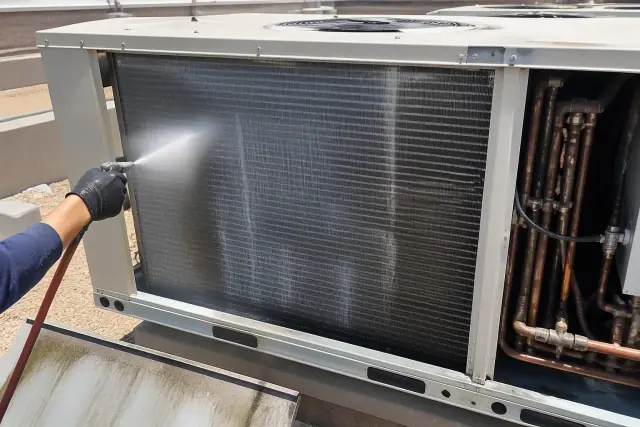
A dust-loaded rooftop condenser coil being cleaned in direct desert sun. Roof-surface temperatures can exceed 115 degrees, making clean coils important for heat rejection and compressor reliability.
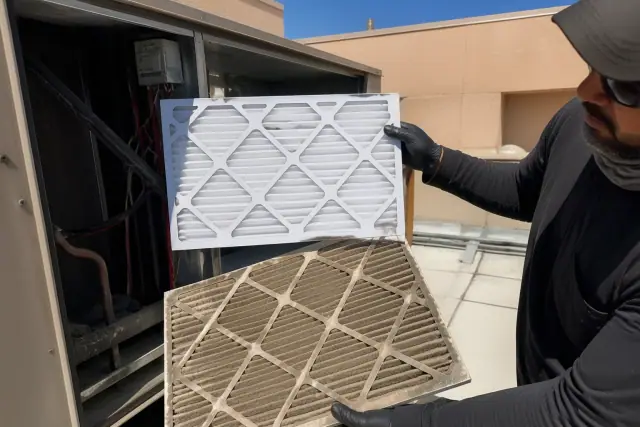
Compare a clean filter with one loaded by desert dust. The contrast shows why a monthly check helps protect airflow between full maintenance visits.
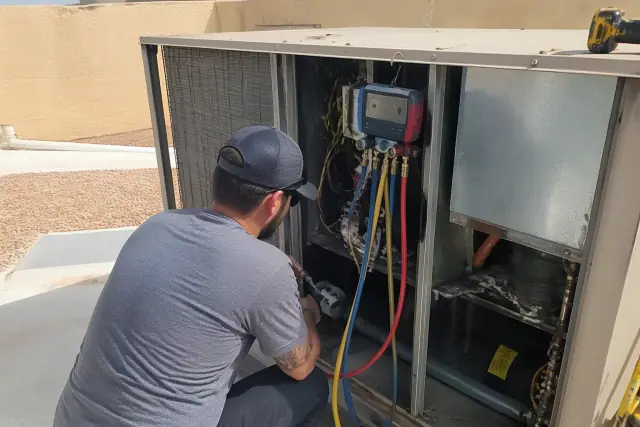
Refrigerant readings beside return- and supply-air measurements. A properly functioning cooling system should produce roughly a 20 degree Fahrenheit drop, so a smaller or larger split helps direct further diagnosis.
A standard office on a 40-hour week generally fits twice-yearly service with monthly filter checks. A call center running three shifts needs attention closer to quarterly than a 9-to-5 office.
A restaurant kitchen operating 16 hours a day, seven days a week warrants quarterly HVAC and ventilation service. Hood and duct grease removal also supports fire-code compliance under NFPA 96 guidelines.
Rooftop units need service at least twice yearly, with additional inspections for equipment older than 12 years. Well-maintained VRF systems may reach 20 to 25 years, but their shared refrigerant piping, controllers, and multiple indoor units require specialized checks.
Schools can use summer and winter breaks for major service that requires a full shutdown. Retail spaces need at least twice-yearly service, with larger anchor stores sometimes moving to quarterly visits as door traffic, customer loads, and coil fouling increase.
| Facility or Equipment | Service Baseline | Maintenance Focus |
|---|---|---|
| Standard office | Twice yearly | Pre-cooling and pre-heating inspections, plus monthly filter checks |
| Restaurant, medical facility, or data center | Quarterly | Grease, high heat load, or continuous run time |
| Industrial or high-load facility | Monthly or quarterly | Process heat, occupancy, production schedules, and equipment redundancy |
| Rooftop unit | Twice yearly minimum | Condenser coils, belts, bearings, and refrigerant charge |
| Commercial refrigeration | Quarterly minimum | Continuous compressor operation and coil fouling from dust or grease |
Begin with two full inspections per year, monthly filter checks, and annual refrigerant-charge verification. Spring service should prepare condenser coils, refrigerant, and compressors for cooling demand; fall service should cover heat exchangers, ignition components, controls, ductwork, and evaporator coils. Document findings so maintenance stays preventive instead of becoming an emergency repair during peak weather.
Phoenix records more than 100 days a year at or above 100 degrees, so cooling equipment accumulates long run times and faster compressor wear. Direct rooftop sun, system age, grease, dust, process heat, occupancy, equipment redundancy, and operating hours can all tighten the interval from twice yearly to quarterly or even monthly. Building automation setpoints and sensor calibration should be reviewed at each scheduled visit, while ductwork should be visually checked during seasonal maintenance.
Owners often ask when to schedule service, when to replace equipment, and how much maintenance costs. In Phoenix, cooling-focused visits fit best from February through April, with heating-side review from September through November; the extended cooling season can run from March through October. Most commercial units last 15 to 20 years, while well-maintained systems may reach 20 to 25 years; the $5,000 rule multiplies unit age by repair cost, so a 10-year-old unit facing a $600 repair scores 6,000 and points toward replacement. A commercial maintenance visit typically costs $200 to $1,000 or more, and some buildings budget around $2.15 per square foot annually, depending on equipment count, age, type, and complexity.
If building use, equipment age, roof exposure, or operating hours make the right interval unclear, share the equipment details and maintenance history. A local commercial HVAC team can help shape an inspection schedule around actual load and system condition.